Wednesday, April 17, 2019

Wondering Who You Are by Sonya Lea

Wondering Who You Are by Sonya Lea
This is the second heartbreaking memoir I've read in a row. It's such a cliché, but it's truly amazing what people can live through and survive.

After twenty-three years of marriage, Sonya Lea's husband, Richard, was diagnosed with an extremely rare form of abdominal cancer. His internal organs were being overtaken by mucous-producing tumor cells and his prognosis was bleak. He decided to undergo an (at the time) experimental surgery. It was a surgery so complex, it was dubbed the MOAS by survivors, the Mother of All Surgeries. 

Unfortunately, during this surgery, things went very, very wrong and his stomach cavity filled up with liters of blood. When he woke up, Richard was not only physically less able, but due to the extreme blood loss, he developed a brain injury that cruelly made him lose his memories and identity. Not only does Richard not recognize the man he has become, his wife must reconcile the fact that the man he used to be - the man she fell in love with and built a life with - likely wouldn't fully return to his former self. 

The chapters start in alternating formats of the early love story between Sonya and Richard when they met and fell in love as teenagers with the years after the surgery to the present day after thirty or so years of marriage. It's a scathingly honest account of how Sonya comes to terms with her family's new normal. Her husband's personality has changed from smart, headstrong and hardworking to passive and agreeable. He tires easily and becomes reclusive. He must undergo a myriad of major rehabilitative therapies in order to try to restore some of his physical and mental abilities. In the meantime, his wife is mourning the former partner she had: the memories they shared, the unique experiences they had that formed them as a couple, and the years of bonding, discussions, and ups and downs that made them into who they each were individually as well as a couple. 

Initially, Sonya was full of resentment. She just wanted the man she loved with to rehabilitate back to his former self. She was angry at finding herself in the role of caretaker and grieving the physical relationship they'd formed as a couple. She was stressed out from a medical malpractice suit they filed and from taking on the brunt of the workload.

As she processed her feelings towards her husband's new state of being, she also started to question her own identity. Over the years, she slowly discovers the ways in which we imprint our own biases and points of view onto our memories and that with enough time and patience, it's possible to slowly rebuild and come to a place of acceptance and understanding. And sometimes, when enough time passes and where there's an abundance of empathy and love, a terrible tragedy can make us come out changed for the better on the other side.

Judge the cover: 5/5

A Mother's Reckoning: Living in the Aftermath of Tragedy by Sue Klebold

A Mother's Reckoning: Living in the Aftermath of Tragedy

On the morning of April 20, 1999, Sue Klebold got up and went to work like any other day. By lunchtime, she received an unsettling frantic phone call from her husband that something happened at her son's school. By afternoon, she was kicked out onto her driveway while swarms of police pulled apart her house, not giving her any information. By evening, neighbours were blocking off swarms of media while the Klebolds bolted into the night trying to find a safe place to stay.

Sue Klebold learned her son was dead. Not only that, she learned he was one of the killers during the Columbine massacre. Her living nightmare had just begun.

A few months ago, I read Columbine by Dave Cullen, a thoroughly researched journalist's account of what happened when teenagers Eric Harris and Dylan Klebold secretly planned and then executed a mass shooting at their high school. A Mother's Reckoning shares the personal side about how that terrible tragedy impacted Dylan's family who was left behind, specifically his mother, Sue. 

How do you get through each day when your world has been turned upside down? How do you grieve your son's death by suicide while simultaneously coming to terms that he was also a sadistic murderer? How do you cope with everyday life when you are suddenly blamed for your son's actions, your surname is now equated to mass murder and you are facing what your lawyer warned you would be "a firestorm of hatred"? What do you do when you need to process your feelings but can't join a support group because the other members could be subpoenaed for information? How can you possibly comfort/apologize to/provide reassurance to parents of children who have been murdered by your own child? How do you return to work when your head is spinning and you can't stop crying? Who can you talk to when absolutely no one can truly relate to the exact situation you're going through? How do you respond to media speculation when everything you, your friends, or family members respond to gets twisted and misrepresented? How do you reconcile memories of what you thought was your normal, loving child with the reality that your child has hidden the most evil, nightmarish secret plans from you? How do you grieve a child you loved with all of your heart, whose monstrous actions you hate, while discovering he wasn't at all the person you thought he was? How do you attempt to convince everyone around you that you honestly, truly had zero idea of your son's intentions? That he simply wasn't the person you raised or knew?

How do you go on?

This is the story that attempts to answer all of these impossible questions. It's about a mother who is left to sift through the wreckage that her life has become as she tries to make sense of the living hell she's been put through. She used to just be a regular mom; in the aftermath, she's broken, terrified, suicidal, a detective of her own life trying to figure out where it all went wrong. It's just as heartbreaking as it sounds, but I can't tell you how much respect I have for this woman who woke up one day as a normal, everyday loving mother and in the blink of an eye found herself thrust into the worst nightmare one could imagine. 

Yet somehow she found a way to go on.

Judge the cover: 3/5

Thursday, April 4, 2019

The Prison Book Club by Ann Walmsley

The Prison Book Club

When her entrepreneurial friend, Carol, asked her to help with book selections for a prison book club she'd established, Ann Walmsley was a bit apprehensive to say the least. A few years prior, Ann was mugged outside her home in London, England. The incident had left her very shaken. As it turns out, her friend was very persuasive, so she decided to give it a go with the idea that she could write a book about the book club. By attending the meetings and giving some of the inmates journals so she could get their perspectives of the book club and prison life, this is Ann's account of an eighteen-month journey where she would leap outside of her comfort zone, tucking away her paranoia along with her preconceived notions of what to expect from the heavily tattooed inmates, as she visited the Collins Bay medium-security prison in Kingston, Ontario, on a monthly basis. She gathered more courage than she thought she had and entered a world she never could have previously imagined she'd end up in...

It's always interesting to recognize landmarks from your everyday life as backdrops in books. One of my favourite thrift shops is located directly across the street from the Collins Bay Institution. If you were passing by and didn't know that it was a prison, it looks like a beautiful limestone castle with a distinctive red roof, often with flocks of Canada Geese wandering freely on the outside grounds. I have always conjured an image of what it's like on the other side of those tall stone razor-topped walls, always carried a "what if" scenario of what I'd hypothetically do if I were to see an escaped inmate running across the street into the parking lot as I'm unloading my bags of thrifted treasures. (I don't know, scream? I've always just hoped the situation stayed hypothetical...)

But after reading so much about the group of inmates who convened at the Collins Bay Book Club, I gained a whole other perspective. First of all, I didn't just admire Ann Walmsley for being brave enough to actually enter a prison and meet with inmates after what happened to her in England, but I equally admire her for her seemingly bold book selections. She often chose books with protagonists who were prisoners themselves, or who had endured abuse or been involved in cover-ups. She chose books that could potentially be considered triggering, but for the very reason that most of the men could relate to these types of situations themselves, it made for such interesting discussions. Through reading about these men, it's evident that we're not so very different as people. They may have found themselves on a different path in life, but apart from that, we can all learn from each other and we can all gain deep insights and emotion from the books we choose to read. The fact that the men were also brave enough to join a book club in the first place gave me a different sense of admiration for them.

Ann and Carol would travel from their luxurious homes in Toronto to Kingston every month to facilitate the prison book club. They were also involved in a women's book club in Toronto where their counterparts were also well-to-do ladies. The two book clubs were complete opposites of each other: the Toronto ladies would have wine and cheese and fancy desserts in a calm, well-appointed condo while the men's prison book club took place in an often stuffy room off the chaplain's office. X-rayed cookies were served from clear packages. (The free cookies were the only thing some of the less literary-minded inmates showed up for.) 

At one point, Ann's women's book club and the men's prison book club read three of the same books simultaneously. They each provided written insights that the other club would read. Carol remarked at one point that "the women's book club gathering was often more emotional than the men's." Maybe so, but the men - perhaps due to the sheer amount of time they had to dedicate solely to reading - often provided certain points of view that never crossed the women's minds. Ann also provided some of the more long-standing members with journals for them to record their observations about the books and prison life. These gave us a better understanding of what they were going through on a daily basis, how they viewed their futures and how the books they were reading helped them process their ideas.

After a few months, Ann and Carol also ended up traveling to the Beaver Creek Institution, a minimum-security prison where Carol had set up yet another book club. (Ann traveled to this prison in order to follow two of the book club members who had been transfered from Collins Bay.) In fact, by the end of the book, we learn that Carol's passion and ambition propels her to operate a book club in every single federal prison in Ontario. She further continued (and likely continues) to open more book clubs in prisons all across Canada, as well as sharing her expertise to help prisons outside Canada who also want to establish their own book clubs. As noted near the end of the book "research continues to point to interesting links between reading literary fiction and the growth of empathy" making her herculean efforts well worthwhile especially for a group who is often left at the fringes of society.

I really enjoyed reading The Prison Book Club, as it reminded me a lot of one of my favourite books about books, The End of Your Life Book Club by Will Schwalbe. Both are great books for true book lovers, for readers who want to discover even more great books and who love hearing other readers' different insights and perspectives. However, one very important thing that you need to be aware of if you plan on reading The Prison Book Club is that (perhaps obviously, since it is a book about a book club, after all...) the books are discussed in-depth, meaning there are spoilers throughout. Deaths, plot twists, and endings are all revealed! But, having already read a few of the books that were discussed, it was interesting to hear what others thought of the books. Some of the discussions reminded me of portions of books that I'd forgotten about or how they made me feel when I read them myself. And, of course, I now have a huge list of more great books to go and check out.

I recommend, like Ann, you go in with an open mind before you enter behind the prison gates of Collins Bay. Sometimes what intimidates us the most doesn't turn out to be quite as scary as we first thought. And this book is proof that books can really bring people together and unite us while opening our minds to worlds we could never ourselves imagine.

Judge the cover: 3/5

Sunday, March 31, 2019

A Sloth's Guide to Mindfulness by Ton Mak

A Sloth's Guide to Mindfulness

This cute little sloth instantly calmed me down. He reminded me to focus on my breath, to enjoy my surroundings and to chill out. That it's good to reach for the stars, but it's okay to go at my own pace.

Who knew a little drawn animal could do so much good for my peace of mind?

It's a quick read that highlights a slow pace. If your mind is going a million miles a minute like mine often does, take the sloth's advice and focus on the present. As he says, you do you, keep mindful and everything will fall into place. Hang in there!

Saturday, March 30, 2019

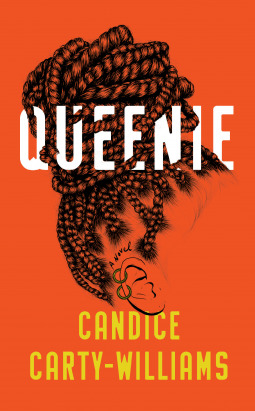
Queenie by Candice Carty-Williams

Queenie

Queenie has man troubles. She's devastated to learn that her long-term boyfriend, Tom, wants to go on a break from their relationship. She's in love with him and can't imagine life without him, but she's forced to move out of their shared apartment until they figure out their future once and for all.

In the meantime, she attempts to distract herself. She goes to a party where her friends fill out an online dating profile for her. Subsequently, between men she meets on OKCupid, a few acquaintances, and a random hookup she meets in a bar, she spends a lot of time using her body rather than her mind to try to mend her broken heart. But no matter how many partners she spends time with, she can't seem to get her true love, Tom, out of her mind.

The shared house she ends up moving into is damp, dirty and gross, so she spends quite a bit of time over at her grandparents' house. They're old-school Jamaicans and set in their ways. They provide some comic relief, as do group text chats with her friends, dubbed "The Corgis". She also spends an inordinate amount of time over at the sexual health clinic due to her rising number of assorted one-(sometimes more) night stands.

Queenie has a lot of potential (both the character and the novel), but for me personally, there's a bit of a disconnect. It has a lot of elements of (forgive me for the terrible term) chick lit - the snappy, fun dialogue and quirky characters - but there are also a ton of elements that could make for a true thought-provoking drama: Queenie's complex relationship issues, her estranged mother-daughter relationship, crippling night terrors and panic attacks, the Black Lives Matter movement and interracial relationships, as well as Queenie's career hanging in the balance as she tackles her mounting personal challenges. 

A word of warning: the sexual encounters with the random men Queenie gets involved with are actually quite horrible and shocking for what at first seems to be a light-hearted novel. They had me cringing and wanting me to grab her from the pages out of those situations to tell her she deserves better than the way she's being treated. Furthermore, while there are flashbacks to her earlier times with Tom, I didn't feel as though I had a complete enough picture of him to care about whether or not they got back together. Some of the characters are downright unlikeable to the point where, again, as a reader, I didn't really care much about what happened with their storylines, while others definitely added likeability and a well-rounded complexity to Queenie's story.

Overall, I'm not quite sure how to rate this one. I really liked certain parts over others and felt that there was a ton of potential. I just felt as though either the lighthearted parts needed to be a lot more funny (doesn't it drive you crazy when a character is doubled over with laughter at a quote that you barely cracked a smile at?) to turn the entire thing into a laughing-at-life comedy or that the author could have taken all of that darker, hard-to-swallow material and made it into more of a sweeping drama. I feel as though the author could have produced a real gem if she'd gone with the latter. It didn't swing quite enough in either direction for me, so I'm going to split this at around an indecisive 3.5-4 stars out of 5. Overall, I thought this was good for a debut novel and would certainly be interested to see what else Candice Carty-Williams writes next.

Judge the cover: 5/5


Thursday, March 28, 2019

Of Mice and Men by John Steinbeck

Of Mice and Men by John Steinbeck

I chose to read Of Mice and Men as part of the Read Harder challenge: to re-read a book that was assigned in school. I can't remember how I felt about this book back when I was a teenager. Bits and pieces were familiar, but I couldn't remember the entire story. I was probably focused on more important things in my life back then, such as daydreaming about Jordan Catalano.

Overall, it was alright - however re-reading it felt a bit like an assignment since it's not a book that I'd gravitate towards nowadays for pleasure. I've never really connected much to the classics. I purposely chose a really short book. I got it out of the way early in the year so I can focus on books I want to read more.

I guess not much has changed, though I've finally moved on from Jordan...

Judge the cover: 4/5

Wednesday, March 27, 2019

The Baltimore Book of the Dead by Marion Winik

The Baltimore Book of the Dead

This little book is an accompaniment to Marion Winik's book titled The Glen Rock Book of the Dead. This second book is comprised of people the author knew who died between 2008 and 2017. 

I was having a bad day when I first picked this up and I didn't immediately connect to it. Who wants to read about a bunch of dead people that someone else knew?, I thought. However, the next day I picked it up again (it's tiny after all, and that cover is so cute). I approached it with a fresh attitude and ended up being really intrigued.

The subjects themselves are not identified by their names, but by little nicknames that the author's bestowed on them. Only about two pages are devoted to each person, but the author manages to sum up what they each meant to her in such a succinct way that even though we aren't given a great deal of detail, a clear image of each person and how much they meant to her comes through.

The summaries almost reminded me of haiku in their precision: each person's essence is distilled down to carefully worded anecdotes and each one ends with a pithy final sentence or two that perfectly sum up the stories and the characters.

These mini eulogies aren't just limited to people, though that's the case for the majority for most of them. There are relatives, mentors, professors, friends, celebrities, a body of water and tales of a goldfish so special one would think it's made up if this book wasn't clearly non-fiction.

This book made me think of the very small number of people I've lost along the way and realize how grateful I am that I haven't lost very many in my lifetime. It's clear how much these people meant to the author, though, and just how lucky she is to have met most of them even though they're no longer on this earth.

Judge the cover: 5/5